
For a quick-service restaurant, a loyalty program is one of the most direct ways to grow customer lifetime value. QSR runs on small tickets and high frequency, so the customers who matter most are the ones who come back week after week. A well-built program turns occasional visits into a habit and gives regulars a reason to choose you over the drive-thru across the street. These seven strategies focus on the metric that ties it all together: customer lifetime value.
What customer lifetime value means for QSR
Customer lifetime value, or CLV, is the total profit a single customer generates over the entire time they keep buying from you. In quick service, three levers drive it:
- Visit frequency: how often a customer comes back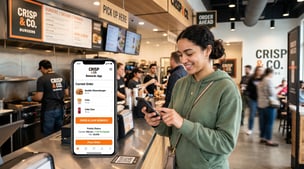
- Average ticket: how much they spend per visit
- Retention: how long they stay a customer before drifting away
A loyalty program is a tool for moving all three. Every strategy below maps back to at least one of these levers, which is what separates a program that grows CLV from one that simply gives away free food.
1. Personalize rewards around real order history
Generic perks get ignored, especially when a customer opens your app expecting it to know them. Use order history to tailor offers: a bonus on the item someone buys every morning, or a nudge toward a category they haven’t tried. Personalization makes regulars feel recognized and gives them a reason to open your app instead of defaulting to a competitor. It lifts both frequency and average ticket, the two levers you can move on every single visit.
2. Choose a structure that rewards frequency
The right structure fits your margins and your customers’ habits. Common models in QSR include:
- Points-based: customers earn points per order and redeem them for menu items. Simple and easy to adopt.
- Tiered: more visits unlock better perks, which pushes frequent guests toward the next level. Chick-fil-A One uses this well.
- Paid subscription: members pay for ongoing value, like Panera’s coffee subscription, which builds a daily reason to visit.
Match the model to the behavior you want to reward, which in QSR is almost always frequency.
3. Make your mobile app the center of the program
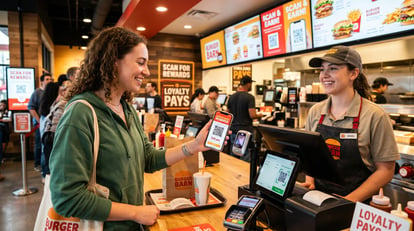 In quick service, the loyalty program and the app are effectively the same thing. The app is where customers order ahead, skip the line, pay, and watch rewards add up in real time.Starbucks built its program around exactly this loop, and the convenience is what keeps customers inside the ecosystem. A frictionless app raises frequency by making your restaurant the path of least resistance.
4. Keep the value obvious and the rules simple
Complexity kills participation. A customer should understand how to earn a reward, how to redeem it, and what they gain, all within a few seconds of signing up. State the value plainly, keep the path to a free item short, and skip the fine print. Simplicity drives more sign-ups and far more repeat engagement than a clever structure no one can follow.
5. Use gamification to build visit streaks
Game-like elements give customers a reason to come back on a schedule. Streaks, limited-time challenges, and bonus-point days turn routine orders into progress toward a goal.Chipotle leans on this with rotating challenges and extra rewards. Surprise perks work too:an unexpected free item deepens the relationship and costs little. Both tactics target frequency directly, which is the fastest lever to move in QSR.
6. Measure CLV, not just sign-ups
Sign-up counts feel good and tell you little. Track the metrics that reflect real value: visit frequency, average ticket, retention rate, and reward redemption. Compare the lifetime value of loyalty members against non-members to prove the program’s return. When a metric slips, respond with a fresh reward or a clearer offer before customers drift.Measuring CLV keeps the program pointed at profit rather than vanity.
7. Keep it fresh and avoid common pitfalls
The quickest ways to stall a program are overcomplicating it and letting rewards go stale. Refresh offerings, retire perks that no longer land, and feed customer feedback back into the design. Looking ahead, expect AI-driven personalization, app-based ordering, and digital wallets to shape what QSR guests come to expect. Staying current is part of protecting the lifetime value you’ve worked to build.
Learn from the QSR programs that lead
The standouts all protect lifetime value by making the next visit effortless. Starbucks Rewards builds everything around a daily-use app with personalized offers. Chick-fil-A One uses tiers to reward frequency. Chipotle keeps members engaged with gamified challenges. Panera’s subscription turns a coffee run into a daily habit. Each one keeps the value obvious and the experience simple, which is the foundation of any loyalty program built to last.
Keep them coming back with Plainsight
A loyalty program brings customers to the door. What happens once they arrive, from order accuracy to speed through the drive-thru, decides whether they come back. Plainsight’s computer vision turns your existing camera feeds into operational data on throughput, service times, and accuracy, the in-restaurant factors that quietly shape visit frequency and retention. Pairing a strong loyalty program with that visibility protects the lifetime value you’ve built on both sides of the counter.
See how Plainsight works for QSR →
Restaurant Waste Management: 7 Strategies to Cut Waste and Costs
4 Ways Computer Vision Is Transforming Quick-Service Restaurants
No Comments Yet
Let us know what you think